

Do not wrong the dead
Φθιμένους μή ἀδίκει
Respect the dead and avoid insulting or harming them, expressing dignity and honor towards human life and their memory.
όταν συμμετέχουμε στον πόνο κάποιου άλλου
More
We should show reverence and respect towards the deceased, avoiding any kind of insult, or harm against them. The importance of maintaining dignity and humanity, even towards the dead, is emphasized. By avoiding any injustice towards the departed, we demonstrate deep respect and honor towards human life and the legacy they left behind, thus keeping their memory alive in the most honorable way.
The Philosopher
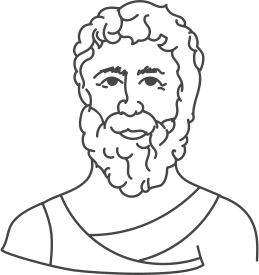
Pittacus
Pittacus, one of the Seven Sages of antiquity, distinguished himself as a politician and general in Mytilene, during the 7th and 6th centuries BC. Born in Mytilene, Pittacus came from the family of Hyrradius, a Thracian of the middle class and an aristocratic mother, but was socially upgraded after his marriage to a member of the powerful Pentilid family in the island.
Military Glory and Political Wisdom
In the political arena, Pittacus entered in 612 BC, when, together with Epimenides and Kikis, he killed the tyrant Melanchros, earning the esteem of his fellow citizens. Militarily, he distinguished himself during the confrontation with the Athenians over Sigeion, where he defeated Phrynons, confirming his reputation as an experienced warrior.
Aisymnetic Tenure and Legislative Reforms
Recognized for his wisdom and virtue, he was elected “aisymnetes,” tasked with peacefully resolving internal disputes. Among his legislative achievements, stands out the law, which imposed double punishment for offenses committed under the influence of alcohol, thus promoting the principle of self-control and responsible civic behaviour.
Final Years and Legacy
After serving his state with devotion, Pittacus chose to live as an ordinary citizen, in his later years, leaving behind an indelible mark of wisdom and justice. His wisdom transcended the borders of the island, making him a reference point for many seekers of wisdom and knowledge throughout Greece.
Further Material
Don’t Speak Ill of the Dead (And Other Nonsense We Learn about Grief)
https://brigitteganger.medium.com/dont-speak-ill-of-the-dead-and-other-nonsense-we-learn-about-grief-393ff530dd9e
(By following the provided link, you will be redirected to a third-party website to access the relevant content)
Our Duty to the Dead
https://philosophynow.org/issues/126/Our_Duty_to_the_Dead
(By following the provided link, you will be redirected to a third-party website to access the relevant content)
Some thoughts on not speaking ill of the dead
https://www.dailymaverick.co.za/opinionista/2018-04-18-some-thoughts-on-not-speaking-ill-of-the-dead/
(By following the provided link, you will be redirected to a third-party website to access the relevant content)
Where Do Our Rights Go When We Die?
https://eachother.org.uk/rights-go-die/
(By following the provided link, you will be redirected to a third-party website to access the relevant content)
Why We’re Taught to Not Speak Ill of the Dead
https://www.nationalreview.com/the-morning-jolt/why-we-are-taught-to-not-speak-ill-of-the-dead/
(By following the provided link, you will be redirected to a third-party website to access the relevant content)
Frequently Asked Questions
Delphic Maxims and the Ancient sages
What are the Delphic Maxims?
These are succinct phrases, just a few words, aimed at guiding individuals in their daily lives, you can learn more here.
Who are the Seven Ancient Sages?
The seven ancient sages were: Thales of Miletus, Pittacus of Mytilene, Bias of Priene, Solon of Athens, Cleobulus of Rhodes, Periander of Corinth, and Chilon of Sparta. More details can be found here.
Are the Delphic Maxims part of a religion?
The Delphic Maxims are a spiritual creation of the seven ancient sages, given as a precious legacy to the Oracle of Delphi. Traditionally, these maxims were directly given by Apollo (Greek ancient God) to the Oracle of Delphi.
I have a question that wasn’t answered above. How can I contact someone?
You can reach us through our contact form or send an email to: info@delphicmaxims.org.
Basic info
What is an NGO?
NGOs are corporate forms of private law, that maintain all the rights and obligations of other legal entities, but are the only types of companies that can receive donations and grants.
Is Delphic Maxims is an NGO?
Delphic Maxims is a Non-Profit Organization where, as an NGO, the distribution of profits to members is prohibited, as profits must remain within the company, for future use.
What is the mission of Delphic Maxims?
Our goal is to present the Delphic Maxims as an empowering guide for personal progress and development, through our website and app, you can learn more here.
What are the Three Foremost Maxims?
These are the three most important Delphic Maxims, that were located on a column in the pronaos, in order to be visible of every visitor, at once! You can learn more here.
I have a question that wasn’t answered above. How can I contact someone?
You can reach us through our contact form or send an email to: info@delphicmaxims.org.
Donations
How can I get a receipt for my donation for tax purposes?
A receipt will be sent automatically within 5 business days after your donation. If you do not receive it, please contact us either through the contact form or at info@delphicmaxims.org.
Can I see the results from my donation?
Every participant in the efforts of Delphic Maxims, whether as a donor, or volunteer, can vote on the next projects to be implemented by the NGO, which will be updated through the website, or newsletter.
What is the tax ID number of Delphic Maxims?
The tax ID number of Delphic Maxims is EL 996671830, and the GEMI (registration) number is 171245707000.
Which is the importance of donations and volunteering?
Contributing to Delphic Maxims, in any way, helps to spread the Delphic Maxims and supports the sustainability of the Company to fulfil its mission.
I have a question that wasn’t answered above. How can I contact someone?
You can reach us through our contact form or send an email to: info@delphicmaxims.org.
Further Material
How are articles linked to the Delphic Maxims?
Articles are chosen based on their relevance to the respective Delphic Maxim, not necessarily referring directly to them, demonstrating the timelessness and cultural depth of the Maxims.
I have a question that wasn’t answered above. How can I contact someone?
You can reach us through our contact form or send an email to: info@delphicmaxims.org.
Blog
Who writes the articles on our blog?
Articles on the Delphic Maxims blog are written by team members and volunteers, you can also contribute by clicking here.
What topics do our blog articles cover?
The theme of the articles is related to a Delphic Maxim or its interpretation, including any issues or events that lead to self-improvement, creativity, and inspiration for the audience, providing answers and positive reflections on personal development.
I have a question that wasn’t answered above. How can I contact someone?
You can reach us through our contact form or send an email to: info@delphicmaxims.org.

