

Do not accuse anyone
Ψέγε μηδένα
Avoid condemning and judging others, demonstrating tolerance and kindness.
φέρομαι σωστά και έντιμα
More
Let’s avoid condemning and judging others, cultivating an attitude of understanding and compassion, instead of harsh criticism. The importance of tolerance, kindness and mutual recognition of our differences, is emphasized, preserving harmony and respect among us. However, this does not mean that we should accept injustices, or unwanted actions, but rather that we should be conscientious and open in dealing with problems, with sensitivity and justice, seeking solutions, that promote peace and coexistence.
The Philosopher
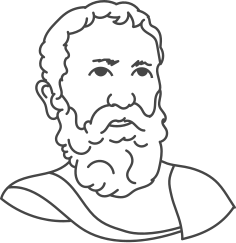
Solon
Solon, a prominent figure in ancient Greece, is renowned for his roles, as a legislator, philosopher and poet. Living between 630 and 560 BC, Solon came from a wealthy and aristocratic family, with descent tracing back to the mythical king Codrus. Despite his noble blood, his family’s financial situation was not prosperous, forcing Solon to engage in trade, through which he managed to travel and enhance his knowledge and wisdom.
Legislative Legacy
Solon left an indelible mark on history with his legislation, which laid the foundations for a fairer social and economic order in Athens. Replacing heritage with income as the criterion for distinguishing citizens into classes, he abolished debts through the “Seisachtheia” and established institutions, such as the assembly of the demos and the council of four hundred, thereby shaping the framework for the development of Athenian democracy.
Poetic Dimension
Solon was distinguished, not only for his legislative initiatives, but also for his poetic talent. Through his poetry, he managed to influence public opinion, inspire and lead the Athenians toward social change. His poetry, characterized by its elegiac and gnomic style, serves as a valuable testimony to the political and social sentiments of his time.
International Presence and Legacy
Solon’s personality and actions were not confined to Athens alone. During his ten years of self-exile, he visited Egypt and Asia Minor, meeting significant figures, such as King Croesus. The exchanges of views and the collection of wisdom from various cultures enhanced his philosophical and political thought, allowing him to shape a richer and more rounded approach to the issues of his time. Solon’s legacy remains alive as a cornerstone of the Western legal tradition and as a source of inspiration for the values of democracy and justice.
Further Material
What is Constructive Criticism & How to Give Negative Feedback
https://www.karrass.com/en/blog/criticism-and-its-negative-effects
(By following the provided link, you will be redirected to a third-party website to access the relevant content)
How to be less judgmental this year
https://humaneeducation.org/4-ways-to-be-less-judgemental/
(By following the provided link, you will be redirected to a third-party website to access the relevant content)
Judging Others | A Toxic Trait You Can Avoid
https://zeinahdagher.medium.com/judging-others-a-toxic-trait-you-can-avoid-235d0e2b0ce0
(By following the provided link, you will be redirected to a third-party website to access the relevant content)
This Is Why Silencing Criticism Will Make You Powerful
https://www.fearlessculture.design/blog-posts/this-is-why-silencing-criticism-will-make-you-powerful
(By following the provided link, you will be redirected to a third-party website to access the relevant content)
Tolerance is more than putting up with things – it’s a moral virtue
https://theconversation.com/tolerance-is-more-than-putting-up-with-things-its-a-moral-virtue-31507
(By following the provided link, you will be redirected to a third-party website to access the relevant content)
What’s Wrong with Criticism
https://www.psychologytoday.com/us/blog/anger-in-the-age-entitlement/201404/whats-wrong-criticism
(By following the provided link, you will be redirected to a third-party website to access the relevant content)
Frequently Asked Questions
Delphic Maxims and the Ancient sages
What are the Delphic Maxims?
These are succinct phrases, just a few words, aimed at guiding individuals in their daily lives, you can learn more here.
Who are the Seven Ancient Sages?
The seven ancient sages were: Thales of Miletus, Pittacus of Mytilene, Bias of Priene, Solon of Athens, Cleobulus of Rhodes, Periander of Corinth, and Chilon of Sparta. More details can be found here.
Are the Delphic Maxims part of a religion?
The Delphic Maxims are a spiritual creation of the seven ancient sages, given as a precious legacy to the Oracle of Delphi. Traditionally, these maxims were directly given by Apollo (Greek ancient God) to the Oracle of Delphi.
I have a question that wasn’t answered above. How can I contact someone?
You can reach us through our contact form or send an email to: info@delphicmaxims.org.
Basic info
What is an NGO?
NGOs are corporate forms of private law, that maintain all the rights and obligations of other legal entities, but are the only types of companies that can receive donations and grants.
Is Delphic Maxims is an NGO?
Delphic Maxims is a Non-Profit Organization where, as an NGO, the distribution of profits to members is prohibited, as profits must remain within the company, for future use.
What is the mission of Delphic Maxims?
Our goal is to present the Delphic Maxims as an empowering guide for personal progress and development, through our website and app, you can learn more here.
What are the Three Foremost Maxims?
These are the three most important Delphic Maxims, that were located on a column in the pronaos, in order to be visible of every visitor, at once! You can learn more here.
I have a question that wasn’t answered above. How can I contact someone?
You can reach us through our contact form or send an email to: info@delphicmaxims.org.
Donations
How can I get a receipt for my donation for tax purposes?
A receipt will be sent automatically within 5 business days after your donation. If you do not receive it, please contact us either through the contact form or at info@delphicmaxims.org.
Can I see the results from my donation?
Every participant in the efforts of Delphic Maxims, whether as a donor, or volunteer, can vote on the next projects to be implemented by the NGO, which will be updated through the website, or newsletter.
What is the tax ID number of Delphic Maxims?
The tax ID number of Delphic Maxims is EL 996671830, and the GEMI (registration) number is 171245707000.
Which is the importance of donations and volunteering?
Contributing to Delphic Maxims, in any way, helps to spread the Delphic Maxims and supports the sustainability of the Company to fulfil its mission.
I have a question that wasn’t answered above. How can I contact someone?
You can reach us through our contact form or send an email to: info@delphicmaxims.org.
Further Material
How are articles linked to the Delphic Maxims?
Articles are chosen based on their relevance to the respective Delphic Maxim, not necessarily referring directly to them, demonstrating the timelessness and cultural depth of the Maxims.
I have a question that wasn’t answered above. How can I contact someone?
You can reach us through our contact form or send an email to: info@delphicmaxims.org.
Blog
Who writes the articles on our blog?
Articles on the Delphic Maxims blog are written by team members and volunteers, you can also contribute by clicking here.
What topics do our blog articles cover?
The theme of the articles is related to a Delphic Maxim or its interpretation, including any issues or events that lead to self-improvement, creativity, and inspiration for the audience, providing answers and positive reflections on personal development.
I have a question that wasn’t answered above. How can I contact someone?
You can reach us through our contact form or send an email to: info@delphicmaxims.org.

