

Guard what is yours
Ἴδια φύλαττε
Be mindful and protect your personal interests with self-confidence and self-awareness, maintaining your health without selfishness.
More
We should pay attention to and protect our own interests, ensuring our personal well-being and growth. The importance of self-confidence, self-awareness and safeguarding our personal interests, is emphasized. This does not imply selfishness, but rather the recognition of the value of being healthy, happy and balanced, in order to be able to provide helpt to other people, when needed. This approach encourages self-esteem and self-respect, providing us with a solid foundation to support both ourselves and those around us, in a more effective way.
The Philosopher
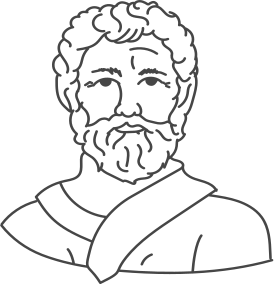
Chilon
Chilon, the son of Damagetos, one of the Seven Sages of antiquity, was born in Sparta, in 600 BC and served as Ephor in 556 BC (during the 56th Olympiad). His governance was marked by success and left a significant imprint on the history of the Spartan regime, enhancing the institution of the Ephors and reducing royal power, in favour of popular sovereignty.
Philosophy and Laconism
Known for his brevity, Chilon represented Laconism, the art of concise and substantive expression. His wisdom, moral integrity and insight, made him an admired figure for subsequent philosophers and later generations.
Teachings and Maxims
For Chilon, the most challenging things for a person were keeping secrets, temperance and enduring injustice. His maxims, such as “Nothing in excess,” “Know thyself,” and “Surety brings ruin,” reflect his deep understanding of human weaknesses and the need for self-awareness and moderation.
Significantly, when asked what is most difficult for a person, he replied: “To keep secrets, to properly dispose of one’s anger and to endure being wronged”… the most difficult for a person is to keep secrets, control their nerves and suffer injustice.
Legacy and Memory
Chilon’s death in Pisa, Sicily, was marked by a fortunate death, occurring as his son returned victorious from the Olympic Games. Sparta honored his memory with a statue and an epigram praising his wisdom and his contributions to the warlike city. Chilon’s sayings at Delphi reflect his enduring influence on the ancient Greek world and the history of philosophy.
Further Material
How To Energetically Protect Yourself
https://insighttimer.com/blog/how-to-protect-your-energy/
(By following the provided link, you will be redirected to a third-party website to access the relevant content)
How to protect your energy no matter where you are
https://www.betterup.com/blog/protect-your-energy
(By following the provided link, you will be redirected to a third-party website to access the relevant content)
Serving Others’ Interests While Neglecting Your Own
https://www.psychologytoday.com/us/blog/science-and-sensibility/201109/serving-others-interests-while-neglecting-your-own
(By following the provided link, you will be redirected to a third-party website to access the relevant content)
The Unselfish Art of Prioritizing Yourself
https://www.psychologytoday.com/us/blog/compassion-matters/201708/the-unselfish-art-prioritizing-yourself
(By following the provided link, you will be redirected to a third-party website to access the relevant content)
You must protect your own interests
https://www.linkedin.com/pulse/you-must-protect-your-own-interests-jorge-rodrigues-simao/
(By following the provided link, you will be redirected to a third-party website to access the relevant content)
Frequently Asked Questions
Delphic Maxims and the Ancient sages
What are the Delphic Maxims?
These are succinct phrases, just a few words, aimed at guiding individuals in their daily lives, you can learn more here.
Who are the Seven Ancient Sages?
The seven ancient sages were: Thales of Miletus, Pittacus of Mytilene, Bias of Priene, Solon of Athens, Cleobulus of Rhodes, Periander of Corinth, and Chilon of Sparta. More details can be found here.
Are the Delphic Maxims part of a religion?
The Delphic Maxims are a spiritual creation of the seven ancient sages, given as a precious legacy to the Oracle of Delphi. Traditionally, these maxims were directly given by Apollo (Greek ancient God) to the Oracle of Delphi.
I have a question that wasn’t answered above. How can I contact someone?
You can reach us through our contact form or send an email to: info@delphicmaxims.org.
Basic info
What is an NGO?
NGOs are corporate forms of private law, that maintain all the rights and obligations of other legal entities, but are the only types of companies that can receive donations and grants.
Is Delphic Maxims is an NGO?
Delphic Maxims is a Non-Profit Organization where, as an NGO, the distribution of profits to members is prohibited, as profits must remain within the company, for future use.
What is the mission of Delphic Maxims?
Our goal is to present the Delphic Maxims as an empowering guide for personal progress and development, through our website and app, you can learn more here.
What are the Three Foremost Maxims?
These are the three most important Delphic Maxims, that were located on a column in the pronaos, in order to be visible of every visitor, at once! You can learn more here.
I have a question that wasn’t answered above. How can I contact someone?
You can reach us through our contact form or send an email to: info@delphicmaxims.org.
Donations
How can I get a receipt for my donation for tax purposes?
A receipt will be sent automatically within 5 business days after your donation. If you do not receive it, please contact us either through the contact form or at info@delphicmaxims.org.
Can I see the results from my donation?
Every participant in the efforts of Delphic Maxims, whether as a donor, or volunteer, can vote on the next projects to be implemented by the NGO, which will be updated through the website, or newsletter.
What is the tax ID number of Delphic Maxims?
The tax ID number of Delphic Maxims is EL 996671830, and the GEMI (registration) number is 171245707000.
Which is the importance of donations and volunteering?
Contributing to Delphic Maxims, in any way, helps to spread the Delphic Maxims and supports the sustainability of the Company to fulfil its mission.
I have a question that wasn’t answered above. How can I contact someone?
You can reach us through our contact form or send an email to: info@delphicmaxims.org.
Further Material
How are articles linked to the Delphic Maxims?
Articles are chosen based on their relevance to the respective Delphic Maxim, not necessarily referring directly to them, demonstrating the timelessness and cultural depth of the Maxims.
I have a question that wasn’t answered above. How can I contact someone?
You can reach us through our contact form or send an email to: info@delphicmaxims.org.
Blog
Who writes the articles on our blog?
Articles on the Delphic Maxims blog are written by team members and volunteers, you can also contribute by clicking here.
What topics do our blog articles cover?
The theme of the articles is related to a Delphic Maxim or its interpretation, including any issues or events that lead to self-improvement, creativity, and inspiration for the audience, providing answers and positive reflections on personal development.
I have a question that wasn’t answered above. How can I contact someone?
You can reach us through our contact form or send an email to: info@delphicmaxims.org.

