

Honor foresight
Πρόνοιαν τίμα
Honor foresight, prepare early, anticipate the consequences of your actions, and stay cautious, rather than acting out of impulse.
More
This Maxim invites you to honor foresight as a basic virtue: to prepare early, to anticipate the consequences of your actions, and to remain cautious, rather than acting on impulse. This principle promotes a mindful life and a long-term horizon, avoiding hasty mistakes and cultivating trust in yourself and others.
The Philosopher
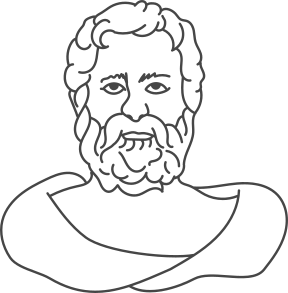
Bias
Bias, one of the Seven Sages of antiquity, lived in Priene in Ionia, during the 6th century BC. The son of Teutamus, Bias was a fervent supporter of his homeland and he is recognized for his unusually strong sense of justice.
Defence of the Unjustly Accused
In the courts, Bias advocated for free, defending unjustly accused citizens, with rare legal prowess. His fame flourished, around 570 BC, a time when Lydia was under the reign of Alyattes and Croesus.
Recognition of Wisdom
A legend states that when the Athenians found a bronze tripod inscribed with: “to the wisest,” they decided to send it to Bias, considering him the wisest of his time. However, when informed, Bias rejected the gift, claiming that only Apollo (the God of ancient Greece) is truly wise.
Teaching and Maxims
Bias’s teachings come to us through maxims, that reflect his deep understanding of life and society. Among these, his view stands out that the ideal democracy is one in which everyone respects the law, as if it were a tyrant, an idea that influenced the political system of Athens.
Legacy and Honor
His compatriots honoured his wisdom and contributions, not only during his lifetime, but also after his death, by erecting a monument in his honour. Bias, who served justice selflessly and modestly, passed away at a great age while defending a fellow citizen in court, leaving behind an admirable legacy of wisdom and humanity.
Further Material
The Future Isn’t What It Used to Be: Here’s How Strategic Foresight Can Help
https://www.apf.org/post/the-future-isn-t-what-it-used-to-be-here-s-how-strategic-foresight-can-help
(By following the provided link, you will be redirected to a third-party website to access the relevant content)
Why Strategic Foresight Ensures Your Organization Is Ready for the Future
https://www.weforum.org/stories/2025/07/strategic-foresight-future-ready-organizations-wef/#:~:text=%2A%20Governments%2C%20businesses%20and%20non,to%20navigate%20the%20future%20proactively
(By following the provided link, you will be redirected to a third-party website to access the relevant content)
How Thinking About the Future Makes Life More Meaningful
https://greatergood.berkeley.edu/article/item/how_thinking_about_the_future_makes_life_more_meaningful#:~:text=How%20Thinking%20About%20the%20Future,Makes%20Life%20More%20Meaningful
(By following the provided link, you will be redirected to a third-party website to access the relevant content)
The Art of Foresight: Preparing for a Changing World
https://thesystemsthinker.com/the-art-of-foresight-preparing-for-a-changing-world/
(By following the provided link, you will be redirected to a third-party website to access the relevant content)
The futility of plans and the importance of foresight
https://www.scmr.com/article/the_futility_of_plans_and_the_importance_of_foresight
(By following the provided link, you will be redirected to a third-party website to access the relevant content)
Frequently Asked Questions
Delphic Maxims and the Ancient sages
What are the Delphic Maxims?
These are succinct phrases, just a few words, aimed at guiding individuals in their daily lives, you can learn more here.
Who are the Seven Ancient Sages?
The seven ancient sages were: Thales of Miletus, Pittacus of Mytilene, Bias of Priene, Solon of Athens, Cleobulus of Rhodes, Periander of Corinth, and Chilon of Sparta. More details can be found here.
Are the Delphic Maxims part of a religion?
The Delphic Maxims are a spiritual creation of the seven ancient sages, given as a precious legacy to the Oracle of Delphi. Traditionally, these maxims were directly given by Apollo (Greek ancient God) to the Oracle of Delphi.
I have a question that wasn’t answered above. How can I contact someone?
You can reach us through our contact form or send an email to: info@delphicmaxims.org.
Basic info
What is an NGO?
NGOs are corporate forms of private law, that maintain all the rights and obligations of other legal entities, but are the only types of companies that can receive donations and grants.
Is Delphic Maxims is an NGO?
Delphic Maxims is a Non-Profit Organization where, as an NGO, the distribution of profits to members is prohibited, as profits must remain within the company, for future use.
What is the mission of Delphic Maxims?
Our goal is to present the Delphic Maxims as an empowering guide for personal progress and development, through our website and app, you can learn more here.
What are the Three Foremost Maxims?
These are the three most important Delphic Maxims, that were located on a column in the pronaos, in order to be visible of every visitor, at once! You can learn more here.
I have a question that wasn’t answered above. How can I contact someone?
You can reach us through our contact form or send an email to: info@delphicmaxims.org.
Donations
How can I get a receipt for my donation for tax purposes?
A receipt will be sent automatically within 5 business days after your donation. If you do not receive it, please contact us either through the contact form or at info@delphicmaxims.org.
Can I see the results from my donation?
Every participant in the efforts of Delphic Maxims, whether as a donor, or volunteer, can vote on the next projects to be implemented by the NGO, which will be updated through the website, or newsletter.
What is the tax ID number of Delphic Maxims?
The tax ID number of Delphic Maxims is EL 996671830, and the GEMI (registration) number is 171245707000.
Which is the importance of donations and volunteering?
Contributing to Delphic Maxims, in any way, helps to spread the Delphic Maxims and supports the sustainability of the Company to fulfil its mission.
I have a question that wasn’t answered above. How can I contact someone?
You can reach us through our contact form or send an email to: info@delphicmaxims.org.
Further Material
How are articles linked to the Delphic Maxims?
Articles are chosen based on their relevance to the respective Delphic Maxim, not necessarily referring directly to them, demonstrating the timelessness and cultural depth of the Maxims.
I have a question that wasn’t answered above. How can I contact someone?
You can reach us through our contact form or send an email to: info@delphicmaxims.org.
Blog
Who writes the articles on our blog?
Articles on the Delphic Maxims blog are written by team members and volunteers, you can also contribute by clicking here.
What topics do our blog articles cover?
The theme of the articles is related to a Delphic Maxim or its interpretation, including any issues or events that lead to self-improvement, creativity, and inspiration for the audience, providing answers and positive reflections on personal development.
I have a question that wasn’t answered above. How can I contact someone?
You can reach us through our contact form or send an email to: info@delphicmaxims.org.

