

Hate violent and offensive behavior
Ὕβριν μίσει
Confront arrogance and offensive behavior with opposition and rejection, promoting respect and courtesy.
έχει κάποιος μεγάλη ιδέα για τον εαυτό του / περιφρονεί
More
It is important to address arrogance and offensive behavior, with understanding and to seek peaceful ways to resolve conflicts. Emphasizing the importance of opposing arrogance, offensive behavior and conceit, not through hatred, but through understanding and reconciliation. Instead of hatred, dealing with empathy and understanding can promote respect, courtesy and peace in human relationships, creating a more positive and supportive environment for everyone.
The Philosopher
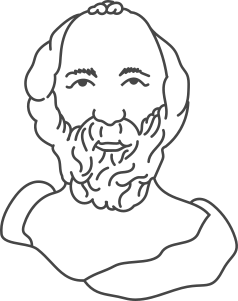
Cleobulus
Cleobulus, known for his inventiveness, served as the tyrant of Lindos, on the island of Rhodes. He emerged as one of the most luminous figures of antiquity and was included in the circle of the Seven Sages. His life began around 630 BC and ended around 560 BC, an age relatively long for that era, with his years spanning a time of great changes and cultural flourishing.
In his personal life, Cleobulus was married and the father of Cleobulina, a young woman noted for the riddles she composed, indicating that the family’s wisdom was not limited to the father alone.
Coming from a royal lineage and claiming descent from Hercules, Cleobulus travelled, in his youth, to Egypt, where he was taught philosophy, by the mystic priests, enriching his wisdom and knowledge.
Political and Cultural Legacy
His reign coincided with that of other great figures, such as Periander and Solon. As a ruler, he played a pivotal role in the political transition of Lindos, towards more liberal and democratic structures.
Regarding his political and cultural contribution, Cleobulus restored significant works of infrastructure and religious worship in Lindos, while the cultural peak, during his reign, left an indelible mark on history.
Poetic Dimension
His poetic discourse, consisting of songs and riddles, totalling some 3,000 verses, reveals the depth of his thought, with his aphorism: “μέτρον ἄριστον” (moderation is best), counted among the most famous ancient Greek sayings, exemplifying the character of the Greek spirit.
Also, attributed to him, is the following riddle:
“One father, twelve sons. Each of them has twice thirty daughters;
Half are white, the others black;
Immortal they are, yet they all end.”
The solution to this is: “time,” as time has twelve months, and each month has thirty days and thirty nights. The days follow one after the other. As one dies, it gives birth to another, and so on.
Legacy
The legacy of Cleobulus is kept alive, through his tomb in Lindos, where an epigrammatic dedication reminds us of his invaluable contribution to cultural and spiritual heritage. Cleobulus remains a luminous figure of the Greek spirit, serving as a source of inspiration and wisdom.
Further Material
8 Ways To Not Be Arrogant (And How Confidence Is Different)
https://www.aconsciousrethink.com/13802/how-to-not-be-arrogant/
(By following the provided link, you will be redirected to a third-party website to access the relevant content)
How Do We Make Humility Important Again?
https://greatergood.berkeley.edu/article/item/how_do_we_make_humility_important_again
(By following the provided link, you will be redirected to a third-party website to access the relevant content)
How To Not Be Arrogant (But Still be Confident)
https://socialself.com/blog/how-to-not-be-arrogant/
(By following the provided link, you will be redirected to a third-party website to access the relevant content)
Humility: What Can It Do for You?
https://www.psychologytoday.com/us/blog/the-forgiving-life/202004/humility-what-can-it-do-you
(By following the provided link, you will be redirected to a third-party website to access the relevant content)
Humility: Why Modern Leaders Need to Resurrect This Ancient Virtue
https://bigthink.com/the-learning-curve/humility/
(By following the provided link, you will be redirected to a third-party website to access the relevant content)
The Antidote to Arrogance
https://www.psychologytoday.com/us/blog/stronger-the-broken-places/201910/the-antidote-arrogance
(By following the provided link, you will be redirected to a third-party website to access the relevant content)
How Humility Will Make You the Greatest Person Ever
https://greatergood.berkeley.edu/article/item/humility_will_make_you_greatest_person_ever
(By following the provided link, you will be redirected to a third-party website to access the relevant content)
Frequently Asked Questions
Delphic Maxims and the Ancient sages
What are the Delphic Maxims?
These are succinct phrases, just a few words, aimed at guiding individuals in their daily lives, you can learn more here.
Who are the Seven Ancient Sages?
The seven ancient sages were: Thales of Miletus, Pittacus of Mytilene, Bias of Priene, Solon of Athens, Cleobulus of Rhodes, Periander of Corinth, and Chilon of Sparta. More details can be found here.
Are the Delphic Maxims part of a religion?
The Delphic Maxims are a spiritual creation of the seven ancient sages, given as a precious legacy to the Oracle of Delphi. Traditionally, these maxims were directly given by Apollo (Greek ancient God) to the Oracle of Delphi.
I have a question that wasn’t answered above. How can I contact someone?
You can reach us through our contact form or send an email to: info@delphicmaxims.org.
Basic info
What is an NGO?
NGOs are corporate forms of private law, that maintain all the rights and obligations of other legal entities, but are the only types of companies that can receive donations and grants.
Is Delphic Maxims is an NGO?
Delphic Maxims is a Non-Profit Organization where, as an NGO, the distribution of profits to members is prohibited, as profits must remain within the company, for future use.
What is the mission of Delphic Maxims?
Our goal is to present the Delphic Maxims as an empowering guide for personal progress and development, through our website and app, you can learn more here.
What are the Three Foremost Maxims?
These are the three most important Delphic Maxims, that were located on a column in the pronaos, in order to be visible of every visitor, at once! You can learn more here.
I have a question that wasn’t answered above. How can I contact someone?
You can reach us through our contact form or send an email to: info@delphicmaxims.org.
Donations
How can I get a receipt for my donation for tax purposes?
A receipt will be sent automatically within 5 business days after your donation. If you do not receive it, please contact us either through the contact form or at info@delphicmaxims.org.
Can I see the results from my donation?
Every participant in the efforts of Delphic Maxims, whether as a donor, or volunteer, can vote on the next projects to be implemented by the NGO, which will be updated through the website, or newsletter.
What is the tax ID number of Delphic Maxims?
The tax ID number of Delphic Maxims is EL 996671830, and the GEMI (registration) number is 171245707000.
Which is the importance of donations and volunteering?
Contributing to Delphic Maxims, in any way, helps to spread the Delphic Maxims and supports the sustainability of the Company to fulfil its mission.
I have a question that wasn’t answered above. How can I contact someone?
You can reach us through our contact form or send an email to: info@delphicmaxims.org.
Further Material
How are articles linked to the Delphic Maxims?
Articles are chosen based on their relevance to the respective Delphic Maxim, not necessarily referring directly to them, demonstrating the timelessness and cultural depth of the Maxims.
I have a question that wasn’t answered above. How can I contact someone?
You can reach us through our contact form or send an email to: info@delphicmaxims.org.
Blog
Who writes the articles on our blog?
Articles on the Delphic Maxims blog are written by team members and volunteers, you can also contribute by clicking here.
What topics do our blog articles cover?
The theme of the articles is related to a Delphic Maxim or its interpretation, including any issues or events that lead to self-improvement, creativity, and inspiration for the audience, providing answers and positive reflections on personal development.
I have a question that wasn’t answered above. How can I contact someone?
You can reach us through our contact form or send an email to: info@delphicmaxims.org.

